Dec 04, 2025
The fundamental difference between the two begins with their core materials, which directly dictate their performance ceilings and suitable domains.
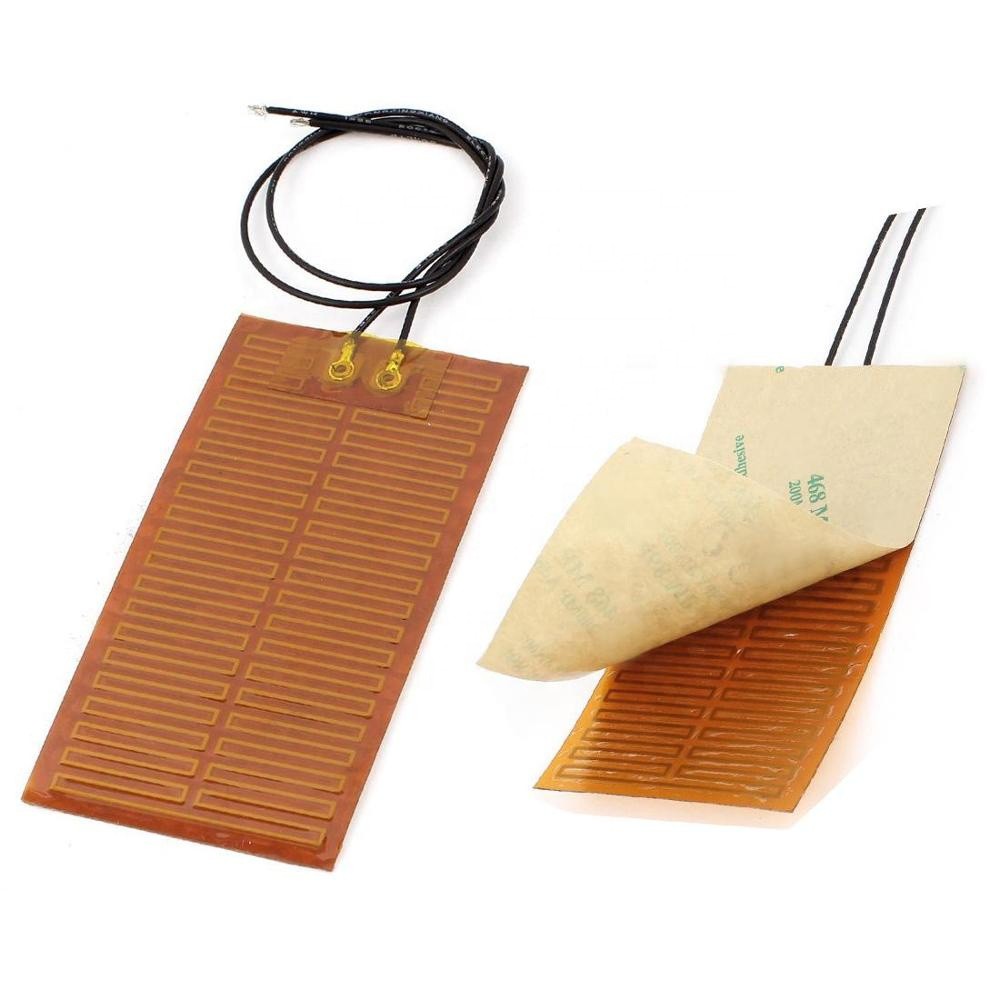
PI Film Heaters are centered around high-performance polyimide film. This material is often called the "apex of the polymer pyramid," formed through the polycondensation of aromatic dianhydrides and diamines, resulting in a rigid molecular backbone. This structure grants it unparalleled inherent properties: exceptional thermal stability, outstanding mechanical strength, and excellent electrical insulation. The heating element is typically an ultra-thin etched alloy foil circuit (e.g., nichrome or stainless steel), encapsulated between two layers of PI film and laminated under high temperature and pressure into an extremely thin (as thin as 0.08mm) and robust unit.
Silicone Rubber Heaters are built around silicone elastomers. Their foundation is a polymer with a silicon-oxygen-silicon backbone, which provides excellent flexibility and thermal stability. During manufacturing, a metal resistance wire/foil or printed paste circuit is usually placed on a fiberglass cloth carrier, then encapsulated by liquid silicone rubber from both sides via pouring or pressing, and finally cured. Here, the silicone rubber acts as both the insulating layer and the encapsulant, forming a flexible and sealed unit.

PI Film demonstrates superior performance in high-temperature endurance. Its long-term stable operating temperature typically reaches 220°C to 250°C, with short-term tolerance exceeding 300°C and a thermal decomposition temperature over 500°C. This is due to the extreme difficulty of polyimide molecular chain breakage at high temperatures. Furthermore, its minimal thickness results in a low thermal mass and extremely fast thermal response (reaching seconds), allowing heat to transfer to the target object with almost no delay, ensuring high efficiency.
Silicone Rubber Heaters generally operate in the range of -60°C to 200°C-230°C (premium products up to 250°C), sufficient for most industrial applications. Their thicker silicone layer (typically 0.8-1.5mm), while slightly slowing thermal response, provides excellent thermal buffering and more uniform surface temperature distribution, preventing localized hot spots.
PI Film possesses very high tensile strength (>100 MPa) and excellent tear resistance, but is not inherently elastic. It can withstand repeated flexing, making it suitable for dynamic flexible structures, but cannot be stretched. Chemically, it is nearly inert, resisting most solvents, fuels, and acids.
The core advantage of Silicone Rubber Heaters lies in their excellent elasticity, compressibility, and conformability. They can tightly adhere to rough or irregular surfaces (like pipes, rollers) and offer good resistance to vibration and shock. The silicone rubber itself provides superior environmental sealing, making them waterproof, moisture-resistant, and dustproof, which is particularly reliable in harsh, wet, oily, or dusty environments.
PI Film offers top-tier electrical insulation with a very high dielectric strength (150-300 kV/mm), making it ideal for high-voltage, high-reliability applications in precision electronics or aerospace equipment. Using photolithography, it enables the fabrication of extremely fine and complex circuit patterns with trace widths and spacing below one millimeter, allowing for precise localized heating and gradient temperature control.
The insulation of Silicone Rubber Heaters (dielectric strength ~20-30 kV/mm) fully meets standard industrial electrical safety requirements. Their design focuses more on reliable functional implementation and environmental durability, offering greater flexibility in shape and size for easier integration.
The choice isn't about simple superiority but precise matching:

In summary, the PI Film Heater is the embodiment of "precision engineering." It pursues ultimate performance parameters (temperature resistance, insulation, response speed) and absolute reliability in harsh environments (high vacuum, strong chemical corrosion), making it suitable for cutting-edge fields with extreme demands on space, weight, and performance.
The Silicone Rubber Heater represents "industrial ruggedness." It emphasizes durability in complex physical environments (vibration, moisture, oil), ease of installation, and perfect conformity to irregular surfaces, making it the most practical and reliable choice for most industrial heating, insulation, and freeze protection applications.
For your next project, if the need leans toward "precision" and "extremes," consider the PI Film Heater. If it leans more toward "durability" and "conformability," the Silicone Rubber Heater will be your steadfast partner. Understanding this fundamental difference is key to making the most engineering-savvy choice.
Previous: How Needle Mica Heating Elements Elevate Modern Heating Solutions?
Next: How Electric Heating Elements Power Industrial Processes: Insights from Jaye Heater?/