In everyday life, core components within appliances like electric kettles, coffee makers, washing machines, and disinfecting cabinets are essential for their function.
Among these, the heating element is paramount. But what exactly is a heating element?
What materials and types are available? Why do some appliances heat up almost instantly while others seem to lag?
This guide provides a comprehensive overview to demystify heating elements, enabling you to make knowledgeable decisions for design, procurement, or repair.
A heating element is an electrical component designed to convert electrical energy into heat through the principle of resistive heating (Joule heating). Its core operation involves passing an electric current through a high-resistance wire, causing it to generate heat. This heat is then transferred to the surrounding medium-be it a liquid, air, or a solid surface.
A typical metal-sheathed heating element consists of three primary components:
- Resistance Wire (Heating Core): Usually made of nickel-chromium (NiCr) or iron-chromium-aluminum (FeCrAl) alloys, this is the component that actually produces heat.
- Thermal Conductive & Electrical Insulating Filler: Magnesium oxide (MgO) powder is commonly packed around the resistance wire. It efficiently transfers heat to the outer sheath while providing critical electrical insulation.
- Metal Sheath: The outer casing, typically made of stainless steel, copper, or aluminum, protects the internal components and directly interfaces with the substance being heated.
The material of the sheath significantly impacts the element's performance, durability, and suitability for specific applications.
- Stainless Steel Heating Elements (e.g., SUS304, SUS316):
- Primary Use: Equipment with high hygiene requirements, such as water dispensers, boiling-water taps, and coffee machines.
- Advantages: Excellent corrosion resistance, high-temperature tolerance, and long service life.
- Suitability: Ideal for direct contact with water and food-grade applications.
- Copper Sheath Heating Elements:
- Primary Use: Traditional water heaters and boilers.
- Advantages: Superior thermal conductivity for rapid heat-up.
- Consideration: Prone to oxidation (tarnishing) and is generally not recommended for food-grade heating.
- Aluminum Heating Elements / Die-Cast Aluminum Heating Blocks:
- Primary Use: Coffee machines, steam mops, and various cleaning appliances.
- Advantages: Very good thermal conductivity, can be manufactured into complex, custom shapes.
- Suitability: Offers a cost-effective balance for medium-duty commercial equipment.
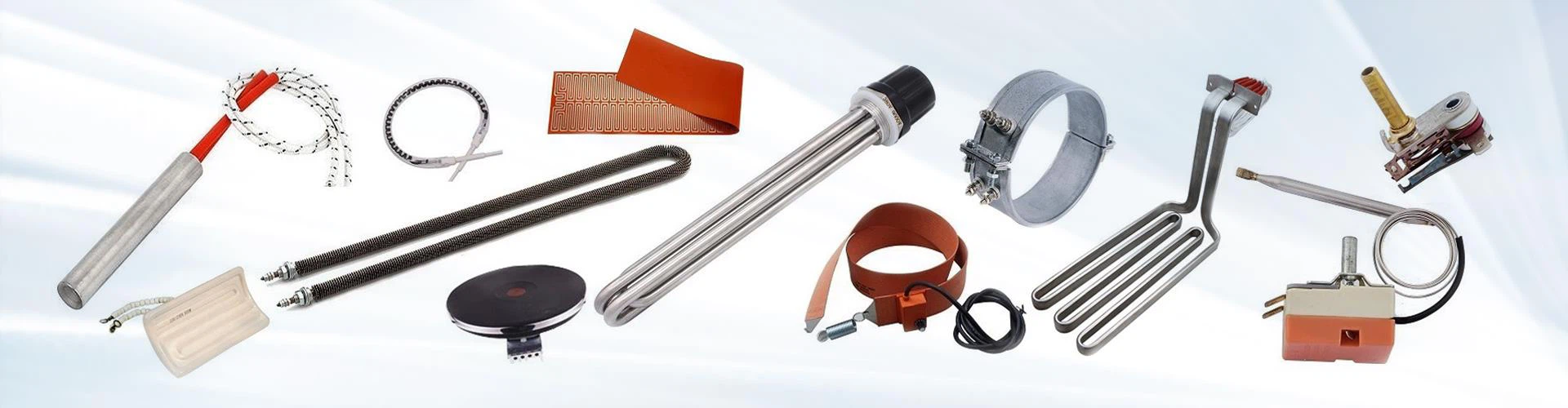
Beyond materials, the physical form of the heating element is tailored to its function.
- Ceramic Heating Elements (PTC - Positive Temperature Coefficient):
- Principle: These do not use a traditional resistance wire. Their resistance increases with temperature, providing inherent self-regulation and a high degree of safety.
- Use Case: Best for low-to-medium power, constant-temperature applications like haircare tools (e.g., curlers) or auxiliary heating in air conditioners.
- Limitation: Generally slower to heat up and not suitable for high-power, rapid-heating demands.
Common Shapes and Their Typical Applications:
Shape / Configuration | Typical Appliance Application |
|---|
U-Shaped Element | Electric water heaters, ovens |
Disc / Plate Element | Egg cookers, hot plates |
Flat Plate Heating Block | Commercial coffee machines, sealing machines |
Tubular Element (Straight/Bent) | Washing machines, disinfecting cabinets |
Die-Cast Aluminum Block | Steam mops, fabric cleaners |
Selecting the correct wattage is critical: higher power is not always better.
Guidelines:
- Household Appliances: Typically range from 500W to 1500W.
- Commercial Equipment: Often require higher-power models, from 2000W to 6000W.
- Critical Factors:
- Ensure the voltage and current ratings match the available power supply to prevent circuit overload.
- Design the system with adequate thermal mass or control to avoid short-cycling, which can damage the element from frequent on/off switching.
- Core Principle: Higher power enables faster heating but also increases energy consumption. The key is to match the power rating precisely to the application's specific thermal requirements.
When sourcing heating elements, ask these essential questions:
- Material & Certifications: Does the material meet food-grade or other necessary safety standards? Look for relevant certifications like RoHS, CE, and ISO 9001.
- Compatibility with Control Systems: Does it support integration with precise temperature control systems (e.g., PID control common in coffee machines)?
- Mechanical Integration: Are the terminal types and mounting method compatible with your appliance's design? Is it serviceable or easy to replace?
- Durability & Protection: What is the expected service life under continuous operation? Does it have an appropriate IP (Ingress Protection) rating for resistance to water or dust?
While a small component, the heating element fundamentally determines an appliance's core performance-heating speed, operational lifespan, and long-term cost of ownership.
Selecting the right element leads to efficient, reliable, and durable products.
Choosing incorrectly, however, often results in increased maintenance, customer complaints, and higher lifecycle costs.
A thorough understanding of materials, types, power requirements, and quality standards is the foundation for making the optimal selection for any application.
One-stop Household Heating Element Factory in China
Jaye Heater will have professional sales and technical staff ready to assist you!