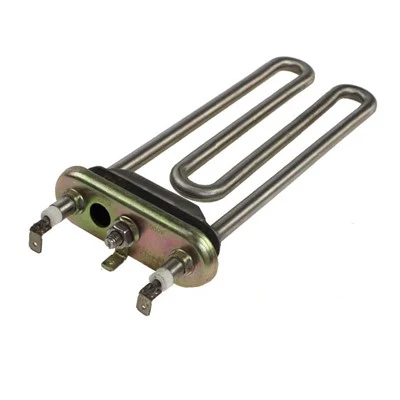
A washing machine heating element is the component responsible for heating the water used during a wash cycle. In most front-loading and drum-type washing machines, the heater is installed through the bottom or lower section of the washing machine tub, with the heating section extending into the water. The most common construction is a tubular heating element. A resistance wire is enclosed inside a metal sheath and electrically insulated with compacted magnesium oxide (MgO). When electrical power is applied, the resistance wire generates heat, which is transferred through the MgO insulation and metal sheath to the surrounding water. The shape, dimensions, mounting flange, sealing gasket, terminals and electrical specifications vary between washing machine designs. For this reason, a replacement or OEM washing machine heating element should be selected according to the actual appliance model, original heater, drawing or installation dimensions rather than power rating alone.
Jaye Heater Technology Co., Ltd. is one of the most reliable manufacturers and suppliers of washing machine tubular heater in China, also supports custom service. Welcome to wholesale high quality washing machine tubular heater at competitive price from our factory.
A washing machine heating element is an electric immersion heater designed to heat water inside the washing machine tub.
Unlike a surface heater that heats an object from the outside, the tubular heater is installed inside the tub assembly so that its heating section is surrounded by water during operation.
A typical heater consists of:
The metal sheath protects the internal heating wire while allowing heat to pass into the water. The MgO filling provides electrical insulation between the resistance wire and the metal sheath while also providing a good path for heat transfer.
This tubular construction is widely used because it can provide substantial heating power in a relatively compact form.

The operating principle is straightforward.
Electrical power → Resistance wire → Heat → Metal sheath → Water
When the washing machine control system switches on the heater, current passes through the resistance wire inside the tube. Electrical resistance converts the electrical energy into heat.
The heat then travels through the compacted MgO insulation and metal sheath before being transferred to the surrounding water.
The heater should remain properly immersed during operation. An industrial washing-machine heater reference from Thermis specifically notes that its heating rods must be submerged during operation.

The structure may look simple from the outside, but several components have to work together.
| Component | Function |
|---|---|
| Metal sheath | Protects the internal heating wire and transfers heat to water |
| Resistance wire | Generates heat when electrical current passes through it |
| MgO insulation | Provides electrical insulation and transfers heat |
| Mounting flange | Secures the heater to the washing machine tub |
| Rubber gasket | Helps seal the mounting opening and prevent water leakage |
| Electrical terminals | Connect the heater to the washing machine circuit |
| Ground terminal | Provides an electrical grounding connection |
| NTC sensor | Measures temperature when required by the control system |
| Thermal fuse | Provides additional thermal protection when specified |
| Ceramic insulators | Electrically isolate the terminals from the metal structure |
The exact terminal arrangement, gasket shape and sensor position need to match the washing machine design.
This is why two heaters with the same voltage and wattage may still not be interchangeable.

Washing machine heaters do not have one universal specification. Voltage, wattage, tube diameter, sheath material, dimensions and safety configuration all depend on the appliance.
The following table gives useful reference specifications for OEM and replacement projects.
| Parameter | Reference / Typical Configuration |
|---|---|
| Product Type | Washing Machine Tubular Heating Element |
| Heating Method | Immersion heating |
| Common Voltage | 110V / 120V / 220V / 230V / 240V |
| Common Power | Approximately 1,500–2,000W; other ratings available |
| Example JAYE Configuration | 230V / 50Hz / 2000W |
| Power Tolerance | Example: +5% / -10% |
| Sheath Diameter | Approximately 6.5–10 mm depending on design |
| Example Tube Diameter | 8.5 mm |
| Sheath Materials | SUS304 / SUS316 / Incoloy 800 / Incoloy 840 and others |
| Insulation Material | Magnesium Oxide (MgO) |
| Heating Wire | Resistance wire |
| Heater Shape | U-shaped / W-shaped / customized |
| Mounting | Flange-mounted |
| Sealing | Rubber gasket |
| Temperature Sensor | NTC / thermostat / other sensor, depending on design |
| Thermal Protection | Fuse or other protection, when required |
| Insulation Resistance | Example JAYE specification: ≥500 MΩ |
| High-Pot Test | Example JAYE specification: 1800V, cold condition |
| Terminals | Customized according to appliance design |
| Grounding | Available |
| Application | Household, commercial and industrial washing equipment |

The metal sheath is an important part of the heater because it is directly exposed to the water and washing environment.
Common material choices include:
SUS304 Stainless Steel
A common choice for general-purpose water-heating applications.
SUS316 Stainless Steel
Can be considered when greater corrosion resistance is required by the water or process environment.
Incoloy 800 / 840
Used for applications where the heater requires a different combination of high-temperature performance and corrosion resistance.
The appropriate sheath material should be selected according to the water chemistry, detergent environment, operating temperature and expected service conditions.
Although the name suggests one specific application, the same basic tubular-heating technology can be adapted to different washing and cleaning equipment.
Household Washing Machines
The most familiar application is the domestic front-loading or drum-type washing machine.
The heater raises the wash-water temperature according to the selected washing program.
Commercial Laundry Machines
Commercial washing machines can require customized heating elements because of their larger water volume, different heating cycles and more demanding operating conditions.
Industrial Washing Machines
Industrial washing equipment may use larger or multiple heating elements to heat water or cleaning solutions.
Parts Washing Machines
Industrial parts-cleaning systems can use immersion heating elements to heat the cleaning liquid.
Industrial Cleaning Equipment
Tubular heaters can also be designed for tanks and cleaning systems where liquid temperature needs to be controlled.
Other Liquid Heating Equipment
With the appropriate electrical, material and mounting design, tubular heaters can be customized for other liquid-heating applications.
If a customer wants a replacement or customized heater, the following information can make the quotation process much faster.
| Information Required | Example / Explanation |
|---|---|
| Washing Machine Type | Household / commercial / industrial |
| Machine Brand & Model | Exact model number if available |
| Original Heater Photo | Front, rear and terminal-side photos |
| Drawing | 2D drawing or CAD drawing |
| Sample | Original heater if available |
| Voltage | 230V |
| Frequency | 50Hz |
| Power | 2000W |
| Tube Diameter | e.g. 8.5 mm |
| Sheath Material | SUS304 / SUS316 / Incoloy |
| Overall Length | Exact dimension |
| Heating Length | Exact dimension |
| Overall Width | Exact dimension |
| Flange Size | Length, width and thickness |
| Gasket Size | Outside / inside dimensions |
| Mounting Hole | Shape and dimensions |
| Terminal Type | Blade terminal / screw terminal / customized |
| Terminal Position | Exact location and spacing |
| NTC | Required / not required |
| Fuse | Required / not required |
| Grounding | Required position |
| Working Temperature | Required water temperature |
| Quantity | Required quantity |
| Testing Requirements | Hi-pot / insulation resistance / other |

The washing machine heating element is a compact but highly application-specific tubular heater. Its job is simple-convert electrical energy into heat and transfer that heat to the wash water-but the actual design involves much more than voltage and wattage.
The tube diameter, heating length, shape, flange, gasket, sheath material, terminal configuration and temperature-sensor position all have to work with the washing machine's mechanical and electrical design.
For standard replacement parts, the washing machine model and original part number may be sufficient to identify a compatible heater. For OEM or customized production, however, a drawing, sample or detailed dimensional information is the best starting point.
JAYE-HEATER provides customized washing machine heating elements based on customer drawings, samples and technical requirements.
Hot Tags: washing machine tubular heater, China, manufacturers, suppliers, factory, wholesale, custom, price, electric, high quality, Immersion Heater For Pool, Immersion Heaters For Water Tanks, Immersion Water Heater For Pool, Industrial Water Immersion Heaters, Plug In Immersion Heater, Tank Immersion Heater