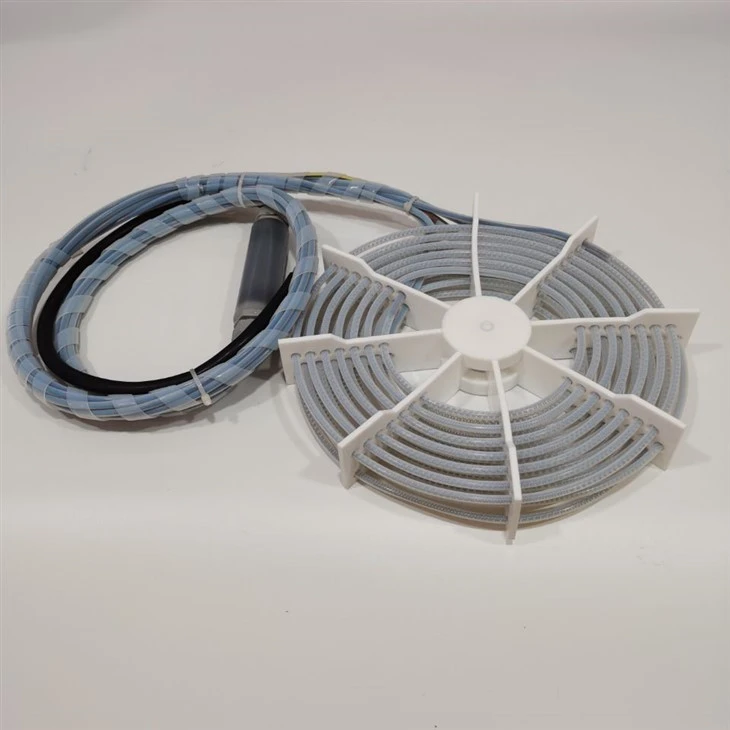
Products Description PTFE Heaters for Electrolyte Equipment & Tanks are designed for heating aggressive chemical solutions in applications where stainless steel or other metallic heaters are not suitable. The heating element is completely enclosed in virgin PTFE, preventing direct contact...
Jaye Heater Technology Co., Ltd. is one of the most reliable manufacturers and suppliers of ptfe heaters for electrolyte equipment & tanks in China, also supports custom service. Welcome to wholesale high quality ptfe heaters for electrolyte equipment & tanks at competitive price from our factory.

PTFE Heaters for Electrolyte Equipment & Tanks are designed for heating aggressive chemical solutions in applications where stainless steel or other metallic heaters are not suitable. The heating element is completely enclosed in virgin PTFE, preventing direct contact between the electrical components and the process liquid while offering excellent resistance to corrosion.
These heaters are widely used in lithium battery production, chemical processing, electroplating, and other industries that require dependable temperature control for highly corrosive liquids. Each heater is manufactured to match the customer's operating conditions, ensuring reliable performance and a long service life.
| Parameter | Specification |
|---|---|
| Voltage | 110V / 220V / 380V / 415V / 480V, Custom |
| Power | 0.5–120 kW |
| Sheath Material | Virgin PTFE |
| Maximum Operating Temperature | Up to 110°C |
| Installation | Flange / Screw Plug / Side Mount |
The specifications above are for reference only. Heater dimensions, power, mounting style, and electrical configuration can all be customized according to the application.
Selecting an appropriate watt density is one of the most important considerations for electrolyte heating. In many lithium battery applications, excessive surface loading may create localized hot spots, affecting both the process liquid and the heater itself. For this reason, Jaye Heater generally recommends a lower watt density whenever the operating conditions allow, helping achieve smoother temperature distribution and improving heater durability.
Temperature sensing can be incorporated directly into the heater assembly. PT100 RTD sensors or Type K thermocouples are available for applications requiring tighter temperature control. Since the sensor is positioned close to the heating element, the control system receives temperature changes more quickly, allowing faster response and more stable PID regulation.
Because no two tanks are exactly alike, every PTFE immersion heater is manufactured according to the customer's requirements. Heater length, flange size, terminal box, electrical connection, sensor arrangement, voltage, and power rating can all be configured to suit new equipment or replacement projects.

PTFE immersion heaters are commonly installed in electrolyte storage tanks used in lithium battery manufacturing. Maintaining a stable liquid temperature helps preserve electrolyte consistency during storage, circulation, and transfer between production processes.
For electrolyte mixing systems, low watt density heaters provide gradual and uniform heating, reducing the possibility of localized overheating while supporting consistent mixing performance.
Electroplating facilities also rely on PTFE heaters because they perform well in highly corrosive plating solutions. Stable bath temperatures contribute to better coating quality and improved production consistency.
In semiconductor wet processing equipment, minimizing metal exposure is often an important requirement. The fluoropolymer sheath offers excellent chemical compatibility while supporting accurate temperature control for high-purity processes.
Other common applications include acid tanks, alkaline solution tanks, chemical dosing systems, and various corrosive liquid storage vessels where conventional metal heaters may suffer premature corrosion.
Whether the project requires an immersion heater for corrosive chemicals, an acid-resistant tank heater, or a customized PTFE heating solution, Jaye Heater can manufacture heaters to match the actual operating environment.
For most electrolyte mixing applications, a watt density of approximately 1.5–2.2 W/cm² is commonly recommended. A lower watt density helps distribute heat more evenly, reduces localized overheating, and can significantly extend the service life of the PTFE immersion heater. The final design should always be selected according to the liquid properties, circulation conditions, and operating temperature.
Jaye Heater uses a virgin PTFE sheath with a fully encapsulated heating structure to help minimize direct metal exposure to the process liquid. This design is well suited for many high-purity electrolyte applications while supporting reliable and consistent heating performance. Material compatibility should always be evaluated according to the specific production process.
Hydrofluoric acid generated from electrolyte decomposition can present challenging operating conditions. Heavy-wall PTFE construction provides improved chemical protection for many applications, but the actual suitability depends on HF concentration, operating temperature, and process conditions. Jaye Heater recommends confirming material selection based on the specific chemical composition before finalizing the heater design.
An internal PT100 sensor or Type K thermocouple provides faster temperature feedback by reducing thermal lag between the heating element and the control system. This improves PID temperature regulation, enhances over-temperature protection, and supports safer, more stable operation, particularly in precision electrolyte heating applications.
Hot Tags: ptfe heaters for electrolyte equipment & tanks, China, manufacturers, suppliers, factory, wholesale, custom, price, electric, high quality, Immersion Heaters in Oil Storage Tanks, PTFE Heaters