Nov 23, 2026
Potentially, yes. But the replacement should be evaluated according to the actual application rather than the brand name alone.
A practical comparison should cover at least these six areas:
| Requirement | What to Check |
| Electrical | Voltage, wattage, resistance, phase |
| Dimensions | Overall length, heated length, diameter, bends |
| Thermal | Target temperature, watt density, heating time |
| Material | Sheath material and compatibility with the medium |
| Installation | Terminals, leads, mounting and connection |
| Application | Air, liquid, surface, mold, oven or other process |
Watlow's own tubular-heater reference data also uses application conditions, watt density, and sheath material as important selection factors rather than relying only on total wattage.
So, an alternative to Watlow heating element does not necessarily mean an identical copy. It means a heater that is technically suitable for the intended application.
A common mistake when replacing an industrial heating element is to compare only:
Voltage + Wattage + Length
These specifications are important, but they may not be enough.
For example, two heaters can both be:
240 V / 2000 W
but have different:
• Heated lengths
• Tube diameters
• Watt densities
• Sheath materials
• Terminal configurations
• Bending shapes
• Heating environments
As a result, they may not behave the same way in the equipment.
A better starting point is to identify:
What is the heater actually heating, and how is it installed?
For example:
• Air or gas heating
• Water or liquid heating
• Oil heating
• Mold or tooling heating
• Oven heating
• Surface heating
• Industrial process equipment
The application determines which specifications deserve the most attention.
If you already have a Watlow heater and want to evaluate an alternative supplier, start with these five groups.
① Voltage and Wattage
Confirm:
• Rated voltage
• Rated wattage
• Phase
• Resistance
• Number of heating circuits
For a simple resistive heater:
P = V² / R
Therefore, the resistance should be checked together with the rated voltage and power.
Do not assume that a heater with the same physical dimensions will have the same electrical characteristics.
② Overall Length and Heated Length
For replacement applications, dimensions can be just as important as electrical specifications.
Check:
• Overall length
• Heated length
• Cold section
• Tube diameter
• Bend dimensions
• Bend radius
• Terminal position
• Lead length
The heated length deserves particular attention.
A replacement with the same overall length but a different heated length can produce a different heat distribution inside the equipment.
③ Sheath Material
The sheath material should be selected according to the actual operating environment.
Relevant factors include:
• Heating medium
• Operating temperature
• Corrosion conditions
• Moisture
• Flow rate
• Contact conditions
For example, a heater used in water does not necessarily require the same sheath material as one used for high-temperature air or a chemically aggressive liquid.
Watlow's reference data shows different sheath materials and watt-density limits for different heated materials and operating conditions.
Therefore, "stainless steel" alone is not a complete technical specification.
④ Watt Density
Watt density is particularly important when evaluating a replacement tubular heater.
A simplified calculation is:
Watt Density = Heater Power ÷ Heated Surface Area
If the power stays the same but the heated surface area changes, the watt density changes.
This can affect:
• Sheath temperature
• Heat transfer
• Material compatibility
• Heating behavior
• Heater operating conditions
For this reason, matching the original voltage and wattage does not automatically mean that the replacement is thermally equivalent.
Watlow's technical guidance also identifies sheath material and watt density as application-dependent factors.
⑤ Terminal and Mounting Configuration
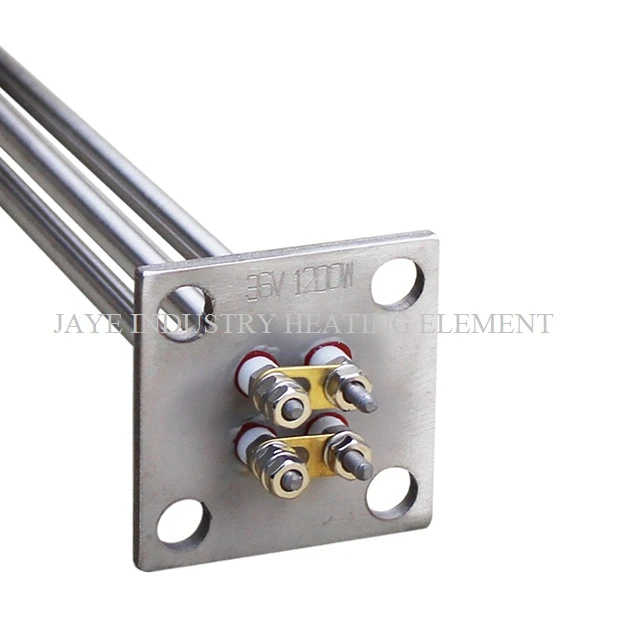
A heater can have the correct voltage, wattage, length, and material but still be difficult to install if the connection configuration is different.
Check:
• Single-ended or double-ended connection
• Terminal type
• Lead wire type
• Lead length
• Terminal spacing
• Mounting brackets
• Threaded connection
• Flange
• Other installation accessories
For OEM replacement projects, it is often useful to send the original drawing or a clear photograph of the heater together with measurements.

The same tubular heating element design should not automatically be used for every application.
Air or Gas Heating
Important factors include:
• Airflow
• Gas composition
• Operating temperature
• Watt density
• Sheath material
• Heater arrangement
For air heating, airflow and heat transfer conditions can influence the appropriate heater configuration.
Liquid Heating
For water, oil, chemicals, or other liquids, consider:
• Liquid composition
• Flow rate
• Operating temperature
• Corrosion conditions
• Immersion depth
• Watt density
• Scale or deposits
The heating element should remain properly immersed over the intended heated section in immersion applications.
Surface or Mold Heating
For surface heating, the fit between the heater and the heated component becomes especially important.
Consider:
• Heater shape
• Contact area
• Bend configuration
• Surface temperature
• Heat distribution
• Installation space
This is one reason custom-shaped tubular elements can be useful for OEM equipment.
A custom tubular heater may be worth evaluating when you have one or more of the following situations:
• The original heater is difficult to source
• The original part has a long lead time
• The required quantity does not fit a standard product
• The heater has non-standard dimensions
• The equipment requires a specific bend shape
• Different terminals are required
• A different sheath material is needed
• The original heater has been discontinued
• You want to develop a second-source supplier
• The equipment requires a new heater configuration
This does not mean that every original heater should be replaced with a custom design.
If a standard replacement already meets the application requirements, a standard product may be the simpler option.
The important point is to compare the actual requirements before deciding.
If you want to qualify an alternative supplier, the following process can reduce unnecessary trial and error.
Step 1 - Collect the Existing Heater Information
Provide:
• Original part number
• Drawing, if available
• Photos
• Voltage
• Wattage
• Dimensions
• Sheath material
• Terminal information
• Quantity
Step 2 - Confirm the Application
Tell the supplier:
• What is being heated?
• Air, liquid, mold, metal surface or another medium?
• What is the target temperature?
• What is the operating temperature?
• Is there airflow or liquid flow?
• How much installation space is available?
Step 3 - Technical Review
The supplier should review:
Electrical + Mechanical + Thermal + Material + Installation requirements
rather than quoting only from the part number.
Step 4 - Sample
For a replacement project, a sample can be used to verify:
• Dimensions
• Resistance
• Power
• Installation
• Temperature behavior
• Heat distribution
Step 5 - Approve the Final Drawing
Before bulk production, confirm the final:
• Dimensions
• Materials
• Electrical specifications
• Terminal configuration
• Tolerances
• Testing requirements
This creates a clear technical reference for future orders.
If you want to find an alternative to Watlow heating element products, you do not necessarily need to prepare a complicated RFQ.
The following information is usually a good starting point:
Electrical
• Voltage: ___ V
• Power: ___ W
• Phase: ___
• Quantity: ___ pcs
Dimensions
• Overall length: ___ mm
• Heated length: ___ mm
• Diameter: ___ mm
• Bend dimensions: ___ mm
Application
• Heating medium: ___
• Target temperature: ___ °C
• Operating temperature: ___ °C
• Equipment/application: ___
Construction
• Sheath material: ___
• Terminal type: ___
• Lead wire: ___
• Mounting requirement: ___
Documents
• Original drawing
• Original part number
• Photos
• Existing heater sample
If some information is unavailable, a clear photo and the original part number can still be useful as a starting point for technical review.
A manufacturer may be able to develop a heater for the same application, but equivalence should be confirmed from the actual specifications and application conditions. A part number alone may not provide enough information.
Not necessarily. Cost depends on material, design complexity, quantity, tooling, testing, certification, and logistics. A custom solution should be evaluated based on total procurement requirements.
Not automatically. Dimensions, heated length, watt density, sheath material, terminal configuration, and operating environment should also be reviewed.
There is no single parameter that determines suitability. For most projects, the combination of voltage, wattage, dimensions, heated length, sheath material, heating medium, target temperature, and quantity provides a useful starting point.
A drawing is helpful but not always essential. Photos, dimensions, the original part number, and a physical sample can also help a manufacturer evaluate the replacement.
For a new supplier or replacement design, sample testing can help confirm mechanical fit and heating performance before larger production quantities are released.
Yes, tubular elements can be formed into different geometries and supplied with different electrical connections and mounting configurations. The achievable design depends on the required dimensions and manufacturing process.
When searching for an alternative to Watlow heating element products, the most useful approach is to start with the application rather than the brand.
Check:
Electrical → Dimensions → Watt Density → Sheath Material → Installation → Application
If these requirements can be properly defined, a custom tubular heating element can be evaluated as a potential replacement or second-source option.
For an existing heater, the fastest way to begin is usually to provide the original part number, drawing or photo, key dimensions, voltage, wattage, application, and quantity.
A qualified heating-element manufacturer can then determine whether the existing specification can be reproduced or whether a modified design would be more appropriate.
1. Watlow - Tubular Elements and Assembly Selection Guide / Reference Data
Watlow's reference material provides application-based information on tubular heaters, including heated materials, watt density, and sheath materials.
2. Watlow - Heater Performance Tips
Watlow discusses the relationship between heating conditions, sheath material, watt density, flow, and the material being heated.
Previous: No Information
Next: JAYE PTC Foil Heater vs. Flextem PTC Heater: Which Is Better for Battery Thermal Management?