Aug 21, 2026
Drying ovens are widely used in industries such as electronics, automotive components, appliances, coatings, packaging, and industrial manufacturing. Since these ovens often operate continuously or for extended periods, heating efficiency has a direct impact on energy consumption and operating costs.
Traditional tubular heating elements can provide reliable heating, but their relatively large size, slower thermal response, and heat loss through the surrounding air can limit overall efficiency in some drying oven designs.
Thick film heaters provide an alternative approach, combining a compact heating structure with efficient heat transfer and rapid thermal response.
A drying oven needs to maintain a stable chamber temperature throughout the drying process. At the same time, the heating system must repeatedly compensate for heat losses caused by:
When the heating elements are inefficient, more electrical energy may be required to maintain the same chamber temperature.
Therefore, improving the efficiency of the heating element can help reduce unnecessary energy consumption.
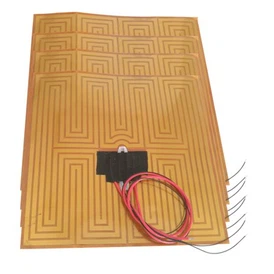
A thick film heater uses a resistive heating circuit printed onto a suitable substrate, typically using thick-film conductive materials.
When electrical power is applied, the printed resistance pattern generates heat across the surface of the heater.
Unlike a conventional tubular heater, where the resistance wire is enclosed inside a metal tube, a thick film heater can place the heating circuit directly on a flat or specially shaped substrate.
This allows the heater to be designed around the required heating area rather than simply relying on a tubular heating element.

The heating circuit is positioned close to the surface that needs to be heated. This short heat-transfer path can reduce unnecessary thermal losses and allow heat to be transferred efficiently into the surrounding air or directly to the target surface.
For drying ovens, this can help the heating system reach and maintain the required temperature with less wasted energy.
Thick film heaters generally have a low thermal mass compared with many conventional tubular heating arrangements.
This allows the heater to respond quickly when the oven temperature changes.
For example, when the oven door is opened and cooler air enters the chamber, the heating system can respond rapidly and restore the target temperature.
Because of their efficient heat transfer and rapid response, thick film heaters can potentially consume less electrical energy than conventional heating tubes for the same heating task.
The actual energy savings depend on the oven structure, insulation, airflow, operating temperature, heater design, and control strategy. However, reducing thermal losses and improving heat transfer can contribute to lower overall energy consumption.
Traditional tubular heaters require sufficient installation space and often need additional structures to support and protect the heating tubes.
Thick film heaters can be manufactured in thin, flat configurations, allowing more flexible installation inside drying chambers.
A more compact heating system can also provide greater freedom when designing airflow and chamber layouts.

| Feature | Thick Film Heater | Traditional Tubular Heater |
|---|---|---|
| Heating structure | Printed resistive circuit | Resistance wire inside metal tube |
| Thermal response | Fast | Relatively slower |
| Heating profile | Easy to customize | Mainly determined by tube layout |
| Size | Thin and compact | Relatively bulky |
| Heat transfer | Short thermal path | Heat passes through sheath |
| Energy efficiency | High potential | Depends strongly on design |
| Installation | Flexible | Requires more installation space |
| Control response | Fast | Relatively slower |
The comparison does not mean that tubular heaters are unsuitable for drying ovens. Tubular heaters remain a proven solution for many high-temperature industrial applications. Thick film heaters become particularly attractive when compact construction, fast response, and energy efficiency are important design requirements.
Thick film heaters can be designed for different heating configurations depending on the oven structure.
The heater can be installed in an air circulation system to heat the circulating air inside the chamber.
Flat thick film heating elements can be integrated into heating panels to provide a more distributed heat source.
Multiple heaters can be independently controlled to create different temperature zones inside a drying chamber.
This can be useful when different areas of the oven require different heating levels.
Drying processes often require precise temperature control. Excessive temperature fluctuations can affect drying time, material quality, and production consistency.
A heating element with a fast thermal response can work more effectively with a temperature controller.
When the required temperature is reached, the heater can quickly reduce its output through the control system. When the temperature drops, it can respond rapidly again.
This helps avoid unnecessary heating and cooling cycles.
Design Considerations
Selecting a thick film heater for a drying oven requires more than simply determining the required wattage.
Engineers should consider:
The heater should be matched to the oven's thermal load and airflow characteristics. Proper insulation and temperature control are equally important for achieving low energy consumption.
For drying oven chambers operating for long periods, energy efficiency is an important part of heating system design.
Compared with conventional tubular heating arrangements, thick film heaters offer a compact heating structure, efficient heat transfer, and rapid thermal response. These characteristics can help reduce unnecessary energy consumption while maintaining stable oven temperatures.
For manufacturers looking to improve the efficiency of industrial drying ovens, thick film heating technology provides another option beyond traditional heating tubes.
The key is not simply using a different heating element, but designing the heater, airflow, insulation, and temperature control system as one integrated heating solution.

Send your inquiry about cosmetic tubes to us and experience the transformative power it can have on your business.
Previous: How to Choose Between Straight, U-Shape, and W-Shape Finned Heaters for Load Bank Configurations?
Next: How the Shift to Steam Irons Is Driving Demand for Precision KST Thermostats?