
Aug 19, 2026
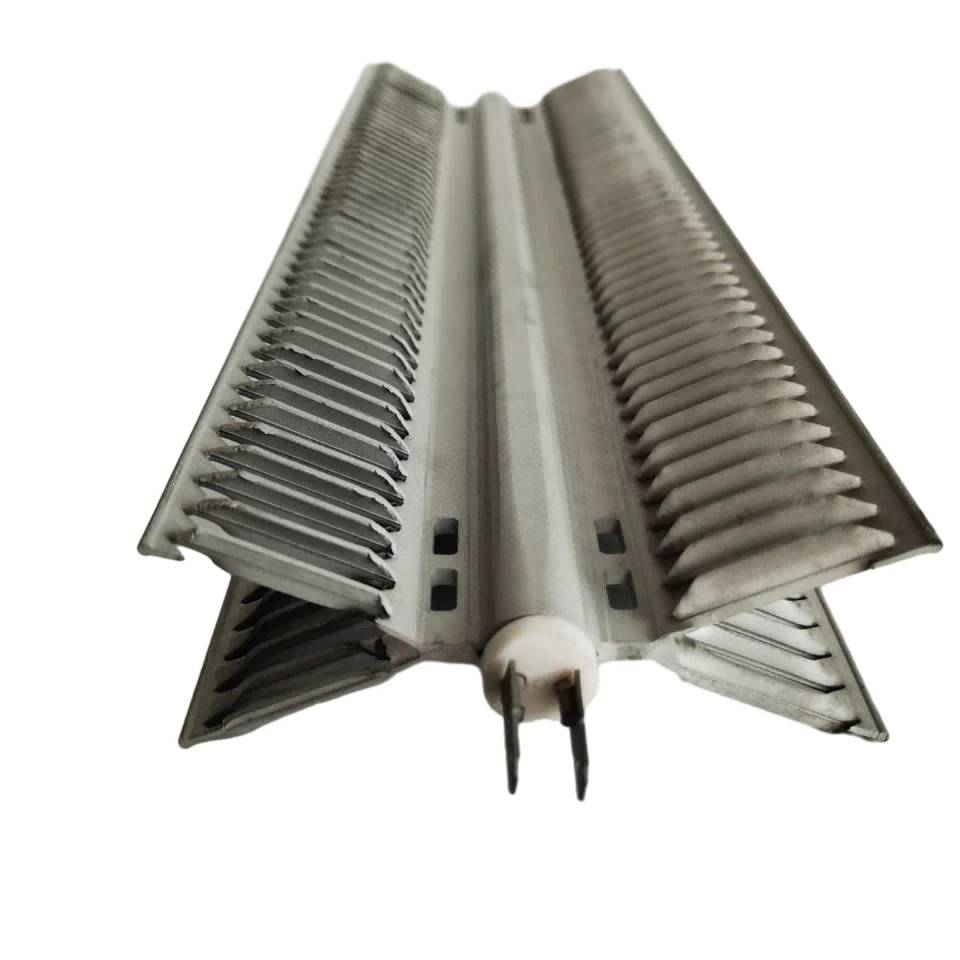
An X-shaped aluminum finned heater consists of a tubular heating element with aluminum fins attached to its outer surface.
The basic structure can be understood as four parts:
When electrical power is applied, the resistance wire generates heat. The heat is transferred through the metal tube to the aluminum fins, and the fins then transfer the heat to the surrounding air.
The process can be simplified as:
Electrical energy → resistance wire → heating tube → aluminum fins → air
The aluminum fins themselves are not the main source of heat. Their purpose is to provide a larger heat-transfer surface around the heating tube.
This is particularly useful for applications where the heating medium is air rather than water or another liquid.
A bare tubular heating element has a relatively small external surface area.
For example, a long tubular heater can generate a considerable amount of heat, but only the outside surface of the tube is directly exposed to the air.
Adding fins changes the situation.
The fins extend away from the tube and create much more metal surface area in contact with the surrounding air. This allows heat to be transferred from the heating tube to a larger volume of air.
This is why finned tubular heating elements are commonly considered when the application requires efficient air heating.
The same principle is used in many other types of heat exchangers: increasing the available surface area can improve the transfer of heat between the heated metal and the surrounding fluid.
The key feature of the product is the geometry of the aluminum fins.
A conventional finned tubular heater may use a relatively simple fin configuration. Depending on the design, the fins may be straight, spiral-wound, or arranged in another repeated pattern.
An X-shaped finned heater uses a different geometry around the heating tube.
The shape of the fins can influence how air passes through the heater.
Instead of simply moving through a relatively open and uniform path, the air encounters angled surfaces and changes direction as it moves through the fin structure.
This can increase air disturbance around the heated surfaces.
However, it is important to understand one point:
The X-shaped structure does not create additional electrical heating power.
A 2000 W X-shaped finned heater is still a 2000 W heater.
The purpose of the fin design is to help transfer the heat generated by the heating element to the air more effectively. Actual thermal performance still depends on the complete design and working conditions, including airflow, fin spacing, heater dimensions, operating temperature and installation arrangement.

The two products use the same basic heating principle, but their fin geometries are different.
| Feature | X-Shaped Aluminum Finned Heater | Conventional Finned Tubular Heater |
|---|---|---|
| Heating principle | Electrical resistance heating | Electrical resistance heating |
| Heating element | Tubular heater | Tubular heater |
| Fin material | Commonly aluminum | Aluminum, steel or other suitable materials |
| Fin configuration | X-shaped / cross-type structure | Straight, spiral or other fin designs |
| Heat-transfer surface | Increased by the fins | Increased by the fins |
| Airflow pattern | Influenced by angled X-shaped fins | Depends on the fin geometry |
| Typical use | Air heating and convection applications | Air heating, HVAC, drying and industrial heating |
| Customization | Available for customized designs | Available for customized designs |
The table shows an important point: there is no completely different heating technology behind the X-shaped version.
The main engineering difference is the external fin structure.

No.
This is one of the most important things to clarify when comparing finned heating elements.
It would be too simple to say that an X-shaped finned heater is always more efficient than every other finned heater.
Heating performance depends on the entire system.
For example, the following factors can have a significant influence:
Airflow
A heater operating under forced airflow behaves differently from one operating under natural convection.
If air is moving rapidly through the heater, the fin structure and spacing can affect the interaction between the air and the heated surfaces.
Fin spacing
Fins that are too close together may restrict airflow.
Fins that are too widely spaced may reduce the available heat-transfer surface.
The correct spacing depends on the application.
Heater surface temperature
The heating element must operate within an appropriate temperature range for the application.
A higher surface temperature does not automatically mean a better heater. The surrounding materials, airflow and control system must also be considered.
Installation space
The heater needs sufficient space for air to pass through the fin structure.
A well-designed heater can still perform poorly if it is installed inside a restricted enclosure where airflow is blocked.
Required outlet air temperature
A heater designed to maintain a moderate air temperature is not necessarily designed the same way as one that must produce a high-temperature air stream.
For this reason, heater selection should always be based on the complete application rather than the fin shape alone.
Customers sometimes compare an X-shaped finned heater with a U-shaped finned heater as though they are two completely different types of heating technology.
Actually, these descriptions can refer to two different parts of the product.
U-shape usually describes the shape of the heating tube.
For example, a tubular heating element can be bent into a U shape to fit a specific installation space.
X-shape usually describes the fin configuration.
Therefore, a U-shaped tubular heater can potentially use a particular fin structure as well.
In other words:
U-shape = tube configuration
X-shape = fin configuration
This distinction is important when discussing a customized heating element with a manufacturer.
If a customer says, "We need a U-shaped finned heater," the manufacturer may still need to confirm exactly what the customer means:
A drawing is often the easiest way to avoid confusion.
When requesting a quotation for a customized X-shaped aluminum finned heating element, voltage and wattage are important, but they are usually not enough.
A manufacturer will normally need as much of the following information as possible:
A clear sample photo with dimensions can also be useful during the initial evaluation.

There is no single fin configuration that is ideal for every air-heating application.
The design needs to balance:
This is why two heaters that look similar from a product photo can still have very different internal specifications.
For OEM projects, the fin geometry should be considered together with the heating tube and the actual operating conditions.
The X-shaped structure can be useful when the application requires a particular combination of heat-transfer surface, airflow path and compact installation. However, the fin shape alone does not determine the performance of the entire heater.
For a customized air-heating application, the most important factors are the complete set of working conditions: voltage, wattage, dimensions, airflow, target temperature, materials and installation requirements.
At JAYE Heater, we manufacture customized heating elements according to the application and available specifications. If you are evaluating an X-shaped aluminum finned heating element, a technical drawing or a reference sample with dimensions is the best starting point for a proper quotation and design evaluation.






