Nov 25, 2026
Flexible heaters use electrical resistance elements laminated or embedded between flexible insulating layers. The insulation material plays an important role in determining the heater's temperature capability, flexibility, thickness, moisture resistance, and suitability for different installation environments.
Three commonly used materials are silicone rubber, polyimide film (often referred to by the trade name Kapton®), and polyester film (PET). Each has a different operating range and construction profile.
Hi-Heat Industries manufactures custom flexible heaters using all three materials, while JAYE Heater Technology offers customized silicone rubber and polyimide flexible heaters. For OEM engineers, the correct choice depends not only on the material itself, but also on the heater construction, operating temperature, mounting method, heat-transfer interface, electrical requirements, and environmental conditions.
There is no universally superior material. Silicone rubber is commonly selected for conformability and industrial durability, polyimide for thin-profile applications with limited installation space, and polyester for lower-temperature heating over relatively large areas.
| Material | Published temperature reference | Main construction characteristics | Typical application fit |
|---|---|---|---|
| Silicone rubber | Hi-Heat: up to 200°C maximum operating temperature | Flexible elastomer insulation, available with wire-wound or etched-foil circuits | Industrial equipment, curved surfaces, tanks, pipes, and outdoor equipment |
| Polyimide (Kapton®) | Hi-Heat: up to 200°C continuous | Thin polyimide film with a laminated resistance circuit | Compact electronics, medical instruments, laboratory equipment, and space-constrained assemblies |
| Polyester (PET) | Hi-Heat: up to 105°C | Thin film insulation for economical, large-area heating | Battery warmers, enclosures, display panels, and low-temperature equipment |
Temperature values above refer to Hi-Heat's published product information, not universal limits for every heater made from these materials. Actual allowable operating temperature depends on the complete heater construction, adhesive, lead wires, mounting interface, and operating conditions.
A flexible heater generally consists of three functional parts:
The substrate material is not the only factor affecting heater performance. Two heaters made from the same insulation material may behave differently if their resistance circuits, thicknesses, watt densities, bonding methods, or installation conditions differ.
Hi-Heat states that its custom flexible heaters use either wire-wound or etched-foil construction depending on the application. JAYE also publishes silicone and polyimide heater configurations using these types of resistance elements.
| Construction | Technical characteristics | Design considerations |
|---|---|---|
| Wire-wound | Resistance wire is arranged in a circuit pattern and embedded between insulation layers | Wire routing, spacing, bending, and local heat distribution need to be considered |
| Etched foil | A thin metal foil is patterned into a defined resistance circuit | Circuit geometry, active heating area, resistance tolerance, and heat distribution are important |
Etched-foil construction can support complex circuit patterns and distributed heating zones.
Wire-wound construction provides another approach for customized heater layouts.
Neither construction is automatically suitable for every material or application; the choice depends on the required electrical and thermal design.
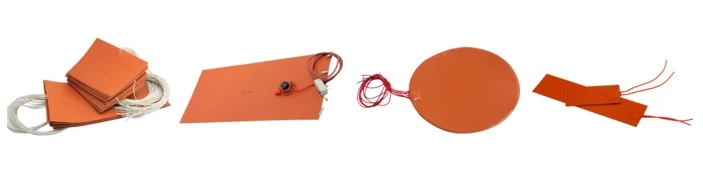
Silicone rubber heaters typically use fiberglass-reinforced silicone rubber as the insulating structure. A resistance wire or etched-foil circuit is embedded between the insulating layers.
The silicone rubber construction provides flexibility and allows the heater to conform to flat, curved, or irregular surfaces. It is commonly used when the heater must maintain close contact with a component or operate in an industrial environment where moisture and mechanical handling are considerations.
Hi-Heat publishes a maximum operating temperature of 200°C for its silicone rubber heaters. Its product information also describes wire-wound and etched-foil options, custom shapes, and different bonding methods.
JAYE's fiberglass-reinforced silicone rubber heater product page lists a standard thickness of 1.5 mm, customized supply voltage, and a maximum power density of 2.5 W/cm², depending on mounting conditions. These are product-specific published specifications, not general limits for all silicone heaters.
Pipes and valves: External surface heating for temperature maintenance or freeze protection.
Tanks and containers: Heating liquids or maintaining the temperature of container walls.
Industrial machinery: Heating equipment housings, plates, and other curved or irregular surfaces.
Food-service equipment: Maintaining the temperature of warming surfaces and equipment components.
Outdoor enclosures: Providing localized heat where low ambient temperatures affect equipment operation.
Silicone rubber is worth evaluating when:
The heater must conform to a curved or irregular surface.
The installation requires a durable, flexible insulating structure.
Moisture resistance is an important material consideration.
The application needs a customized shape, mounting arrangement, or heating-zone layout.
However, silicone rubber should not automatically be treated as waterproof or suitable for immersion. A heater's moisture resistance depends on its complete construction, edge sealing, lead exit, connectors, and installation. The required IP protection must be confirmed for the specific design.
Related product: JAYE Fiberglass Reinforced Silicone Rubber Heating Element
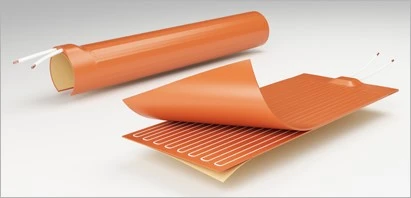
Polyimide heaters use a thin etched-foil resistance circuit laminated between layers of polyimide insulating film.
Kapton® is a registered trademark of DuPont.
It is commonly used to describe polyimide-film heater constructions, although the exact film grade and complete heater design should always be confirmed.
Compared with conventional silicone rubber heaters, polyimide constructions can offer a thinner, lighter profile.
This makes them relevant to assemblies where installation space, component weight, and close thermal contact are important.
Hi-Heat describes its Kapton polyimide heaters as thin-profile products for rapid heat transfer and lists applications involving aerospace, medical, and other specialized equipment. Its product range also includes custom shapes and wattages.
JAYE's published flexible polyimide heater specifications include:
These figures apply to the specific JAYE product listing and should not be treated as universal specifications for all polyimide heaters.
Polyimide is worth evaluating when:
Low outgassing, chemical resistance, and temperature performance should be confirmed against the selected film grade and complete heater assembly. These properties should not be assumed from the word "Kapton" alone.
Related product: JAYE Flexible Polyimide Heater
Polyester heaters use a thin polyester film as the insulating substrate around the resistance circuit.
They are commonly designed for low-profile heating over relatively large surface areas.
Compared with silicone rubber and polyimide constructions, polyester heaters are generally positioned for lower-temperature applications where an economical, lightweight heating solution is required.
Hi-Heat lists a maximum temperature of 105°C for its polyester heaters. Its product information also describes adhesive backing, mounting cut-outs, insulation options, thermostats, thermocouples, RTDs, thermistors, and high-limit protection.
Polyester is worth evaluating when:
Polyester should not be selected solely because the heater operates at a low wattage.
The maximum operating temperature, bonding adhesive, local hot spots, and temperature-control method must all remain within the approved limits.
Related reference: Hi-Heat Polyester Heaters

The following table compares the three materials using Hi-Heat's published temperature references and product descriptions.
| Selection factor | Silicone rubber | Polyimide (Kapton) | Polyester (PET) |
|---|---|---|---|
| Hi-Heat published temperature reference | Up to 200°C | Up to 200°C continuous | Up to 105°C |
| Profile | Generally thicker than film-based constructions | Thin-film construction | Thin-film construction |
| Flexibility | Suitable for conforming to curved surfaces | Suitable for compact and low-profile assemblies | Suitable for flat or gently curved surfaces |
| Moisture considerations | Moisture-resistant construction; sealing still matters | Moisture-resistant construction according to Hi-Heat | Product-specific moisture resistance must be confirmed |
| Typical design emphasis | Durability and surface conformity | Low profile and close thermal contact | Economical large-area heating |
| Common application direction | Industrial equipment and curved surfaces | Compact precision equipment | Low-temperature, large-area heating |
This is a material-selection guide, not a universal performance ranking. Thickness, flexibility, temperature capability, dielectric properties, and service life depend on the specific film or rubber grade, resistance circuit, lamination, adhesive, and manufacturing process.
Choosing the substrate is only one part of flexible heater design. The following technical factors should be checked before confirming a custom heater.
Confirm the normal operating temperature, maximum heater temperature, start-up conditions, and any short-duration temperature peaks.
The heater's temperature limit may be lower than the insulation material's maximum temperature because the complete assembly also includes adhesive, leads, terminals, sensors, and other components.
For example, Hi-Heat lists polyester heaters up to 105°C, while its silicone and Kapton product pages publish different temperature capabilities. These values should be checked against the specific product construction rather than generalized to every material grade.
Watt density is calculated as:
Watt density = Rated power ÷ Active heating area
For example, a 100 W heater with an active heating area of 200 cm² has an average watt density of 0.5 W/cm².
However, average watt density does not establish the actual surface-temperature distribution. The resistance pattern, cut-outs, inactive margins, mounting interface, and heat loss all influence the thermal result.
A higher watt density does not automatically mean faster or more effective heating. The application must be evaluated under representative installation conditions.
The mounting method affects heat transfer between the heater and the heated component.
Common options include:
The adhesive's service temperature must be compatible with the operating temperature of the heater assembly.
Hi-Heat publishes different bonding methods for its flexible heater products, including factory vulcanization, RTV silicone adhesive, and pressure-sensitive adhesive options. Its bonding-method page specifies different service-temperature limits for different adhesive types.
A heater's maximum temperature should therefore not be assumed to apply to every bonding configuration.
A flexible heater may be supplied with a thermostat, thermocouple, RTD, thermistor, or thermal fuse, depending on the design.
The sensor position affects the temperature being measured. A sensor attached directly to the heater surface may not measure the same temperature as a sensor mounted on the heated component.
Engineers should define whether the controlled temperature refers to:
Independent overtemperature protection may also be required depending on the equipment's safety design.
Before production, confirm:
These requirements should be specified for the complete heater assembly and verified against the relevant drawings and test criteria.
Among the three materials discussed, silicone rubber and polyimide are generally used in higher-temperature flexible heater designs than polyester. Hi-Heat publishes up to 200°C for silicone and Kapton heaters, compared with up to 105°C for its polyester heaters.
The actual allowable operating temperature must be checked against the specific heater construction, adhesive, leads, and installation conditions.
Polyimide heaters are commonly designed with a thinner film-based construction than conventional silicone rubber heaters. This makes them useful where installation space and component weight are limited.
However, actual thickness depends on the resistance circuit, insulation layers, adhesive, and manufacturing design. Compare the complete heater thickness rather than the substrate material alone.
Not automatically. Polyester heaters are generally intended for lower-temperature applications, while silicone rubber heaters are used in a wider range of industrial heating environments.
A replacement evaluation should compare operating temperature, watt density, mounting method, surface geometry, moisture exposure, and electrical requirements.
Silicone rubber itself has moisture-resistant properties, but that does not mean every silicone rubber heater is waterproof or suitable for immersion.
The complete heater design, lead exit, edge sealing, connector, and mounting arrangement determine its environmental protection. An IP rating or immersion requirement must be confirmed for the specific configuration.
Wire-wound heaters use resistance wire arranged in a defined circuit pattern, while etched-foil heaters use a patterned metal foil circuit.
Both can be used in flexible heater constructions. The appropriate design depends on the required heater geometry, electrical resistance, heat distribution, thickness, and production requirements.
Yes, custom flexible heaters can be designed with specific shapes, mounting holes, notches, and cut-outs, depending on the resistance circuit and manufacturing process.
The drawing should identify the active heating area, non-heated areas, mounting features, lead exit, and minimum clearances. A finished heater should not be cut or modified unless the manufacturer has specifically designed it for that purpose.
[1] Hi-Heat Industries – Products: Silicone Rubber, Polyester, and Kapton Heaters
[2] Hi-Heat Industries – Silicone Rubber Heaters
[3] Hi-Heat Industries – Polyester Heaters
[4] Hi-Heat Industries – Bonding Methods
[5] Hi-Heat Industries – Flexible Heater Materials: Silicone vs. Polyester vs. Kapton
[6] JAYE Heater Technology – Fiberglass Reinforced Silicone Rubber Heating Element
[7] JAYE Heater Technology – Flexible Polyimide Heater
[8] JAYE Heater Technology – What Materials Are Used in Flexible Foil Heaters?

JAYE Heater Technology manufactures customized silicone rubber heaters and polyimide flexible heaters for industrial and OEM applications.
Previous: No Information