Nov 16, 2026
Band heaters play an important role in injection molding machines. They provide controlled heat to the barrel, nozzle, and other cylindrical components, helping maintain the temperatures required for plastic melting and processing.
However, not all band heaters have the same construction or performance characteristics. Mica, ceramic, and cast-in designs each offer different advantages depending on operating temperature, heat transfer requirements, installation space, and production conditions.
In this guide, we look at common band heater types and compare the product approaches of TriVolt, Durex, Tempco, and JAYE to help equipment manufacturers and buyers make a more informed choice.
During injection molding, plastic material must be heated to the appropriate processing temperature before it can be injected into a mold. The machine barrel is usually divided into several heating zones, each requiring controlled heat input.
Band heaters are installed around the outside of the barrel to transfer heat to the metal surface. Proper heater selection helps maintain stable barrel temperatures and supports consistent processing conditions.
Common installation locations include:
The correct heater depends on the machine design, resin processing temperature, barrel dimensions, and required heating output.
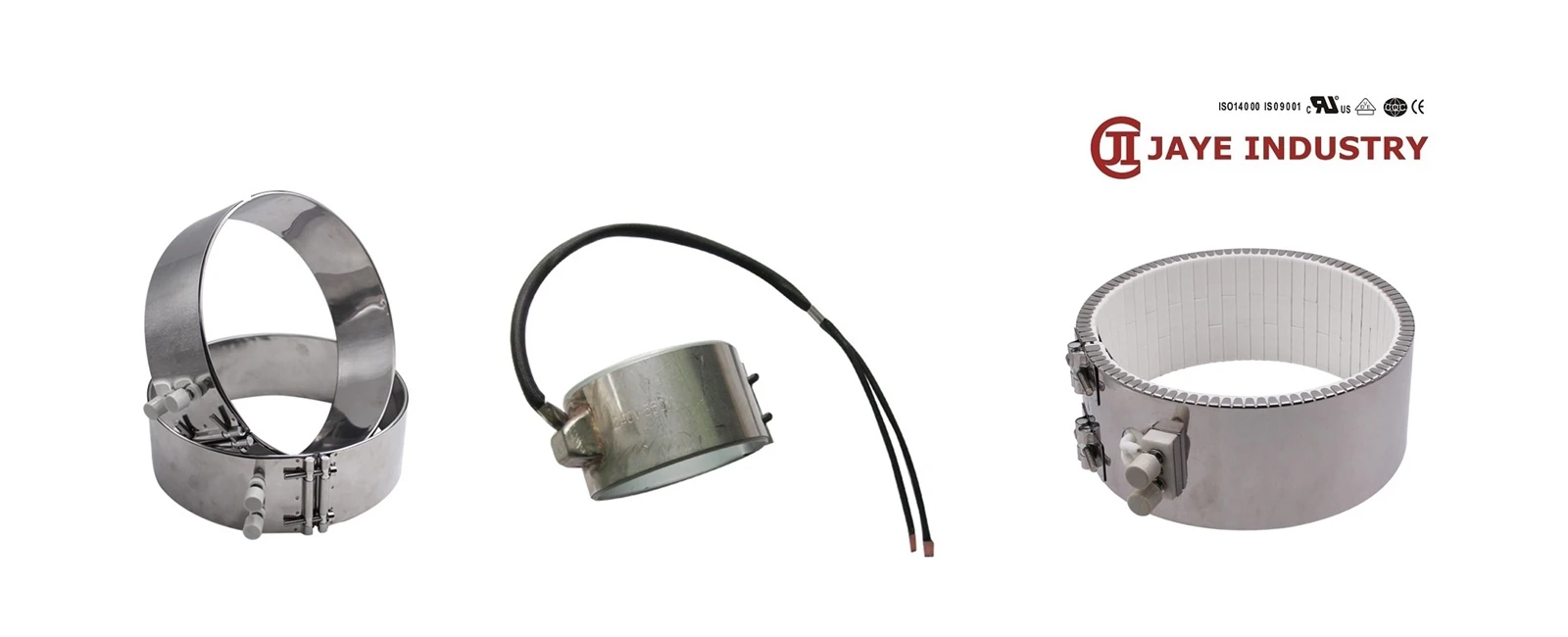
Mica band heaters use mica insulation between the resistance heating element and the outer metal sheath. They are widely used in plastic processing because of their relatively compact construction and practical installation.
Typical characteristics include:
Mica band heaters are often selected for general-purpose barrel heating. Their suitability depends on the required operating temperature, watt density, and installation conditions.
Ceramic band heaters use ceramic insulation and typically incorporate a ceramic fiber insulating layer within their construction.
Their insulation structure can help reduce heat loss from the outer surface. They are commonly considered for applications with higher temperature requirements or where heat retention is an important factor.
Typical characteristics include:
Ceramic band heaters may be a suitable option when the operating conditions exceed the practical range of a standard mica heater. However, the actual temperature capability must be checked against the manufacturer's specifications.
Cast-in band heaters have tubular heating elements embedded in a metal casting, commonly aluminum or other selected alloys.
Unlike conventional clamped band heaters, the heating element is integrated into the cast body. This design can provide a close-fitting heating assembly and is useful for applications requiring a specific mechanical structure.
Typical characteristics include:
Cast-in heaters are generally considered for more specialized equipment designs. Their tooling, manufacturing process, and installation requirements may differ from conventional mica or ceramic band heaters.
Different manufacturers offer different heater constructions and customization options. The following overview focuses on their publicly presented product ranges rather than ranking their overall quality.
TriVolt offers mica and ceramic band heaters for plastic processing applications, including injection molding, extrusion, and blow molding.
Its mica band heaters can be manufactured with different dimensions, wattages, voltages, holes, cutouts, and terminal configurations. Ceramic band heater options are also available for applications requiring different thermal characteristics.
TriVolt is worth considering when a project requires a choice between mica and ceramic insulation, together with customized electrical connections and mounting arrangements.
Durex Industries offers cast-in band heater solutions for industrial processing equipment.
Its product range includes air-cooled and liquid-cooled cast band heaters, as well as different cast shapes and configurations. Available casting materials include aluminum, bronze, copper alloys, and iron, depending on the design.
Durex is particularly relevant for equipment manufacturers looking for integrated cast heating and cooling assemblies or specialized barrel heating structures.
Tempco provides a broad range of industrial band heaters for injection molding and other heating applications.
Its product families include mica-insulated Duraband heaters, ceramic band heaters, cast-in band heaters, and other specialized designs. The range covers different operating environments, watt density requirements, and installation configurations.
Tempco is a useful reference when comparing several band heater technologies within one manufacturer's product portfolio.
JAYE Heater supplies industrial heating elements, including customized band heaters for plastic processing equipment.
For injection molding applications, heater specifications can be developed according to the machine's barrel dimensions, required voltage and wattage, installation structure, and electrical connection requirements.
JAYE focuses on practical customization for equipment manufacturers and industrial buyers. Depending on the project, customers can discuss:
For buyers looking for a customized heater rather than a standard replacement part, JAYE can review drawings, photographs, and technical requirements before providing a quotation.
| Heater Type | Main Construction | Typical Application Focus |
|---|---|---|
| Mica Band Heater | Resistance element with mica insulation | General injection molding and extrusion barrel heating |
| Ceramic Band Heater | Resistance element with ceramic insulation | Selected higher-temperature applications and heat retention requirements |
| Cast-In Band Heater | Tubular elements embedded in a metal casting | Specialized barrel heating and integrated heating or cooling designs |
The right choice is not determined by insulation material alone. Machine design, operating temperature, watt density, installation conditions, and maintenance requirements all need to be considered.
Mica band heaters are widely used for general barrel heating. Ceramic band heaters may be considered for selected higher-temperature applications, while cast-in heaters are used in specialized equipment designs.
Not always. They may differ in thickness, installation structure, watt density, and operating characteristics. Before replacing one type with another, check the machine's available space and heating requirements.
The main dimensions include the inner diameter and width. You should also record the voltage, wattage, terminal position, lead direction, and any holes or cutouts.
Reference
TriVolt – Mica Band Heaters and Ceramic Band Heaters.
Durex Industries – Cast Band Heaters.
Tempco – Band Heaters and Duraband Heaters.
Previous: Watlow Heating Element Substitute: What to Match for a Drop-In Replacement
Next: Screw Plug Immersion Heaters: Chromalox vs JAYE Design & Material