Sep 15, 2026
When people think about factory automation, they usually picture robotic arms, conveyors, sensors, servo motors and PLC control systems.
But there is another component hidden inside many automated machines: heating elements.
Heating is often not the main function of an automated machine. Instead, it supports a specific step such as sealing, melting, bonding, forming, drying, curing or temperature maintenance. In many cases, the heater is only a small component, but the production process cannot work correctly without it.
So, where is heating actually used inside automated equipment?

Packaging automation is one of the clearest examples.
Automatic packaging machines may need heat for sealing plastic films, cutting thermoplastic materials or maintaining the temperature of sealing jaws. Cartridge heaters are commonly installed inside sealing bars, jaws and other compact tooling because they can transfer heat directly into a metal component.
The required heater is usually small and localized rather than a large heating system.
Depending on the machine design, manufacturers may use:
This combination allows the machine to heat only the area where the packaging material contacts the tooling. Industrial heater suppliers identify sealing bars, heat-sealing equipment and packaging machinery as common cartridge-heater applications.

Plastic processing equipment is another major area where automation and heating work together.
Injection molding machines, extrusion equipment and thermoforming systems can contain several independent heating zones. These zones may include barrels, nozzles, molds, manifolds and dies.
Different heater designs are used according to the geometry:
The important point is that automated production does not necessarily require more heating power. It often requires more precise heat placement and temperature control.
For plastic processing, even relatively small temperature deviations can affect polymer viscosity, flow and finished-part consistency, which is why multiple heating zones and closed-loop temperature control are commonly used.

Automated adhesive dispensing is another application that is easy to overlook.
Hot-melt adhesive must remain sufficiently fluid while it moves through the equipment. If the adhesive cools and solidifies inside a hose, nozzle or dispensing head, production can stop.
A typical automated hot-melt system may therefore use several heating points:
Heating pot → heated hose → dispensing gun/nozzle
Cartridge heaters can heat the adhesive reservoir or dispensing components, while flexible silicone heaters can be wrapped around hoses or other surfaces.
Watlow describes an industrial hot-melt application in which cartridge heaters melt the adhesive in the reservoir, silicone rubber heaters heat the hoses, and another cartridge heater heats the dispensing gun.
This is a good example of how different heater types can work together inside one automated machine.
Some automated assembly machines use heat as part of the joining process.
For example, equipment may heat a pressing tool, bonding fixture or contact surface before applying pressure to a component. This can be used when a material requires heat-assisted bonding, forming or curing.
Here, the heating element is often integrated directly into the tooling.
A cartridge heater is useful when the tool contains drilled heating holes. A silicone heater may be more suitable when the required heating area is a thin, flat or irregular surface.
The heater therefore becomes part of the machine's mechanical tooling rather than a separate heating cabinet.
Not all heating happens by direct contact.
Automated production lines may also need to heat moving air for drying, preheating or process stabilization.
Examples include:
For these applications, finned tubular heaters, strip heaters, PTC heaters and air heaters can be considered depending on the required air temperature, airflow and control method.
The basic difference is important:
Solid surface heating → cartridge, silicone, band or tubular heater
Moving-air heating → finned or air heater
Liquid heating → immersion or circulation heater
This simple classification can help automation engineers identify the right heating principle before selecting a specific heater.

Heating is not always used to make a product hot.
In some automated equipment, a small heater is used simply to keep an enclosure or component above the dew point and reduce condensation.
Electrical cabinets, sensors, optical equipment and other sensitive assemblies may operate in environments with temperature and humidity changes. Small silicone heaters, PTC heaters or other low-power heating elements can be integrated into the enclosure to provide localized heat.
In this case, the target temperature may be relatively low. The purpose is thermal stability and moisture control, not high-temperature processing. Silicone heaters are commonly used for condensation prevention in electronic housings and equipment enclosures.
The easiest way to select a heater is not to start with the heater name.
Start with what needs to be heated.
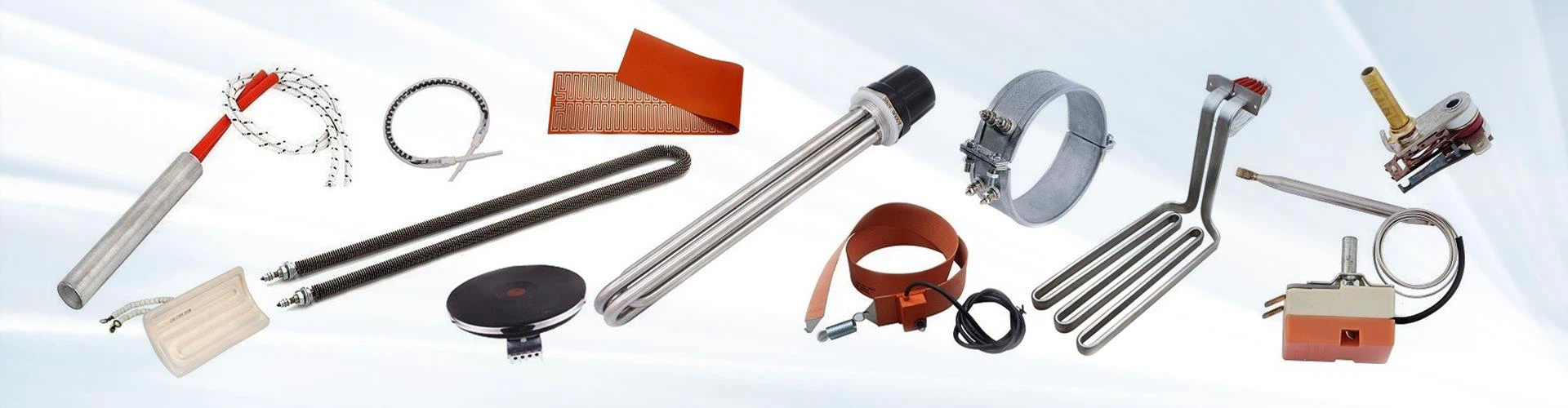
| What needs to be heated | Common heating solution |
|---|---|
| Metal block or mold | Cartridge heater |
| Cylindrical barrel or nozzle | Band heater |
| Flat or irregular surface | Silicone heater |
| Moving air | Finned tubular / air heater |
| Water, oil or process liquid | Immersion heater |
| Surface without direct contact | Infrared heater |
| Electrical enclosure | Silicone / PTC heater |
| Sealing or cutting tooling | Cartridge / strip heater |
This approach is more useful than simply asking for a "heater for automation equipment."
The heater must also match the available installation space, voltage, wattage, operating temperature, heating area, heat-loss conditions and temperature-control method.
As factories become more automated, heating elements are often becoming less visible but more integrated.
A modern automated machine may not have one large heater. Instead, it may contain several small heating zones: one inside a sealing jaw, another around a nozzle, another on a hose, and another inside an electrical enclosure.
That is why heater selection for automation equipment is often an engineering question rather than a simple spare-parts purchase.
The key question is not simply:
"Which heater do we need?"
It is:
"Where does the process need heat, how should that heat be transferred, and how precisely does it need to be controlled?"
Once these three questions are clear, the appropriate heating technology becomes much easier to identify.

Send your inquiry about cosmetic tubes to us and experience the transformative power it can have on your business.
Previous: What Applications Use Mica Open Air Heaters?
Next: Why Is Insulation Material Important in Electric Heating Elements?