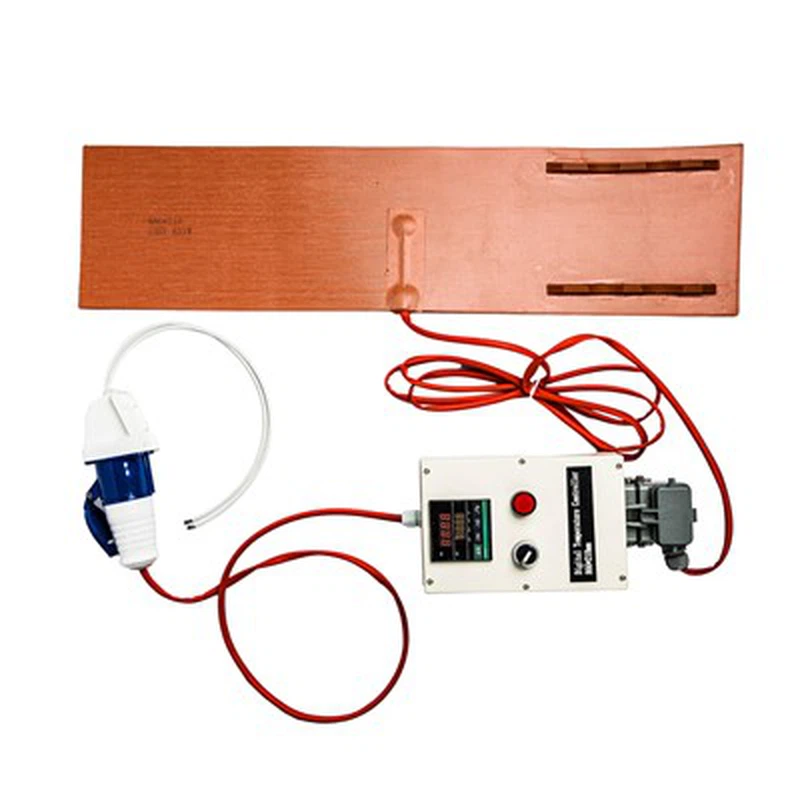
A silicone drum heater is a flexible, wraparound electric heating device specifically designed to evenly heat and maintain the temperature of materials inside metal or plastic cylindrical drums. For epoxy resins (especially two-part systems), its primary purposes are to reduce viscosity, maintain fluidity, ensure homogeneous mixing, and guarantee stable processing performance during application or potting.
Working Principle (Detailed Step-by-Step)
1. Structure and Components
- Heating Element: Inside are flat resistance wires arranged in an even mesh or serpentine pattern to ensure uniform heat distribution.
- Insulation Layer: The resistance wires are sandwiched between double layers of silicone rubber. Silicone offers excellent temperature resistance, electrical insulation, flexibility, and some chemical resistance.
- External Protection: The outermost layer is usually reinforced fiberglass cloth or thicker silicone, providing mechanical protection and durability.
- Fastening System: Equipped with hook-and-loop straps (Velcro), elastic bands, or spring-and-hook systems for easy and secure fastening around the drum.
- Temperature Control System: Must be connected to a temperature controller and a temperature sensor (e.g., thermocouple or PT100 RTD). The sensor is typically placed between the heater and the drum wall, or inserted into the resin for precise feedback control.
2. Operational Process
Step 1: Installation & Wrapping
Wrap the silicone heating blanket snugly around the outer wall of the drum containing the epoxy resin (often a standard 55-gallon/200-liter drum or smaller pails). Ensure the blanket covers the area corresponding to the material level.
Secure it tightly using the fastening straps, ensuring good contact between the heating surface and the drum wall to minimize heat loss.
Step 2: Connection & Control
Connect the heater's power cable to the output of the temperature controller.
Place the temperature sensor at the designated spot (recommended on the middle of the drum wall, or using a long probe inserted into the material). Connect the sensor to the input of the controller.
Set the desired target temperature on the controller. For epoxy resin, this is usually above ambient but well below its curing initiation temperature (e.g., for epoxy that is viscous at room temperature, it might be set between 35°C-50°C, always consult the material datasheet).

Step 3: Heating & Temperature Maintenance
- Upon powering on, electric current flows through the resistance wires, generating Joule heat.
- Heat is conducted through the silicone layers to the metal/plastic drum wall.
- The drum wall then conducts the heat to the epoxy resin in contact with it.
- Heat gradually spreads throughout the resin via thermal conduction and convection, uniformly warming the entire contents.
- The temperature sensor monitors the temperature in real-time and feeds the signal back to the controller.
- The controller uses a PID algorithm (Proportional-Integral-Derivative) to dynamically adjust the power output (e.g., using an SSR - Solid State Relay for on/off or phase-angle control):
- When temperature is below the setpoint, it heats continuously or at higher power.
- When temperature approaches or reaches the setpoint, it reduces power or cycles off, only compensating for heat loss.
- This creates a closed-loop control system, precisely and steadily maintaining the epoxy resin temperature within the set range.

Key Advantages for Epoxy Resin Drums
- Uniform Heating: The large-area wraparound design prevents localized hotspots (which could cause premature curing) or uneven heating.
- Precise Temperature Control: The closed-loop control is crucial for viscosity management and process stability of epoxy resins.
- Safe and Reliable: Silicone material has excellent insulation, preventing electrical leakage.
- Flexible, durable, and tear-resistant.
- Often includes over-temperature protection (built-in thermal fuses or secondary controller protection).
- Ease of Use: Easy to install and remove, reusable on different drums.
- Energy Efficient: Heat is transferred directly to the drum and material, offering high thermal efficiency and saving energy compared to heating in large ovens.

Summary
Silicone drum heaters work by snugly wrapping around an epoxy resin drum with their flexible structure, converting electrical energy into uniform thermal energy, which is then regulated by a precise closed-loop temperature control system to safely, accurately, and efficiently maintain the epoxy resin at its optimal working temperature. They are a standard and essential tool in modern industries like composite manufacturing, electronic potting, and marine construction for handling viscous, temperature-sensitive chemicals. Proper selection and use are key to leveraging their benefits, ensuring safety, and guaranteeing product quality.
Contact now