
Aug 17, 2026
When choosing an immersion heater for an industrial tank, the heating material is just as important as the heating power. PTFE and stainless steel are two common choices, but they are designed for different working conditions. A stainless steel immersion heater is often suitable for water, oil, and other relatively mild liquids, while a PTFE Immersion Heater is a better option when the liquid is corrosive or chemically aggressive.
The main difference is the material that comes into direct contact with the liquid. A stainless steel immersion heater uses a metal sheath to protect the internal heating element, while a PTFE Immersion Heater uses a PTFE outer layer.

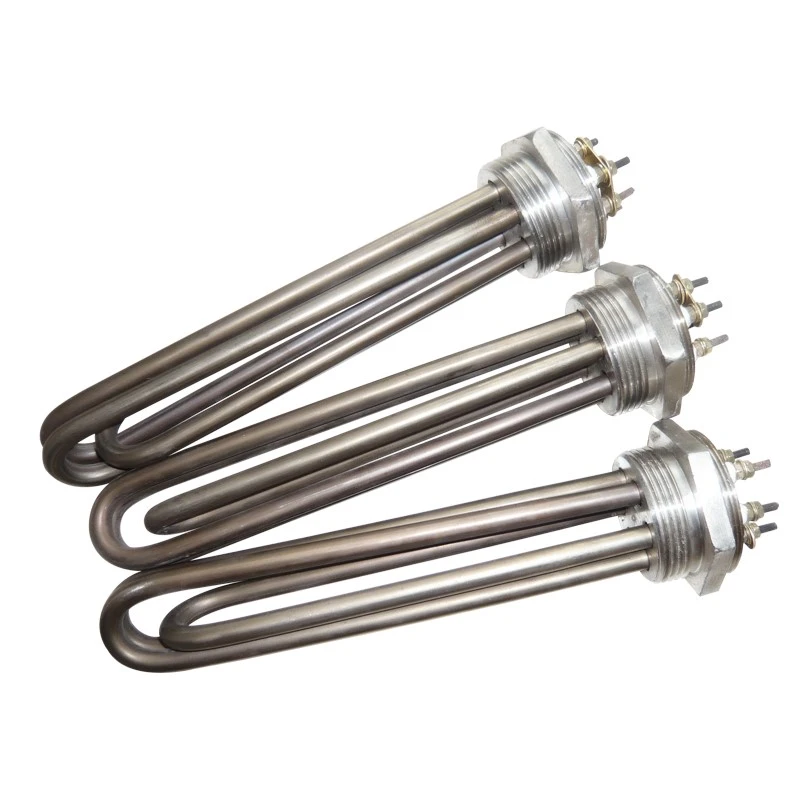
| Feature | PTFE Immersion Heater | Stainless Steel Immersion Heater |
|---|---|---|
| Chemical Resistance | Excellent | Depends on stainless steel grade and liquid |
| Corrosive Liquids | Highly suitable | Application dependent |
| Water Heating | Suitable | Excellent |
| Oil Heating | Application dependent | Commonly used |
| Acidic Solutions | Suitable for many solutions | Depends on chemical concentration |
| Alkaline Solutions | Suitable for many solutions | Depends on chemical concentration |
| Mechanical Strength | Moderate | High |
| Heat Transfer | Good | Generally higher |
| Customization | Available | Available |
| Typical Applications | Chemical tanks, plating, surface treatment | Water tanks, oil tanks, industrial process heating |
For corrosive liquid heating, chemical resistance is often more important than maximum heat transfer.
The PTFE layer creates a protective barrier between the heating element and the process liquid. This helps reduce corrosion of the heating element when it is exposed to many aggressive chemical solutions.
For example, PTFE Immersion Heaters for Chemical Tanks can be used for heating cleaning solutions, chemical processing liquids, and other industrial fluids. The heater can also be customized according to the tank dimensions, heating length, voltage, and required power.
Another advantage is that PTFE has a relatively non-reactive surface. This is useful in processes where the heating material needs to have minimal interaction with the liquid.
PTFE is not automatically better than stainless steel for every application.
If the liquid is water, oil, or another non-corrosive medium, a stainless steel immersion heater may be a more practical solution. Stainless steel provides good mechanical strength, efficient heat transfer, and can be manufactured in a wide range of shapes and sizes.
For high-temperature applications, the specific stainless steel grade and heater construction should also be considered. The operating temperature, liquid composition, concentration, and flow conditions all affect the appropriate heater material.
Therefore, the right question is not simply "PTFE or stainless steel?" It is "Which sheath material is suitable for the liquid and operating conditions?"
Before selecting an immersion heater, consider these factors:
1. What liquid are you heating?
Identify the liquid and its chemical composition first.
2. Is the liquid corrosive?
If the liquid contains acids, alkalis, or other aggressive chemicals, PTFE may be a better choice.
3. What temperature is required?
The heater material and construction should match the actual operating temperature.
4. How large is the tank?
Tank volume and heat loss affect the required heating power.
5. How quickly does the liquid need to be heated?
Heating time is important when calculating the required wattage.
6. Does the heater need to be customized?
Heating length, tube diameter, voltage, power, lead wire, and mounting configuration can be designed according to the equipment.
There is no single material that is best for every application.
For water, oil, and general industrial liquid heating, stainless steel is often a practical and economical choice. For corrosive chemical solutions, electroplating baths, and surface treatment liquids, a PTFE Immersion Heater can provide better chemical resistance and longer service potential.
At Jaye Heater, we can customize PTFE Electric Immersion Heaters according to the actual application instead of using a one-size-fits-all design. Providing the liquid type, volume, target temperature, heating time, voltage, and tank dimensions allows us to recommend a suitable heater design and power rating.

Upgrade your heating systems with Jaye Heater's premium components. For reliable heating elements and precise thermal controllers that ensure performance and safety, contact our experts today for a quote and technical support. Let's find your perfect heating solution.






