May 14, 2026
Infrared heating technology is widely used across modern industrial processes such as plastic forming, drying systems, packaging lines, food processing equipment, and printing machines. While most users focus on wattage, voltage, or heater size, one important factor is often overlooked: the surface coating of the infrared heater.
Different coatings can significantly change how heat is delivered, how energy is used, and how stable the process becomes. Choosing the wrong type may lead to uneven heating, unnecessary energy loss, or even damage to equipment over time.
This guide breaks down the three most common infrared heater coating types-gold, white, and clear (no coating)-and explains how they work in real industrial applications, especially for quartz tube heaters and carbon fiber infrared heaters.
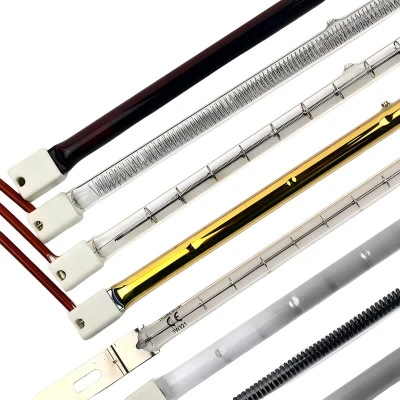
Infrared heater coatings are thin functional layers applied to the outer surface of heating tubes. Their purpose is not decorative-it is technical.
In simple terms, coatings control how infrared energy behaves. They determine whether heat is:
Gold coating is one of the most widely used options in high-efficiency industrial heating systems.
A thin reflective gold layer is applied to part of the quartz tube surface. This layer reflects infrared radiation forward, instead of allowing it to escape in all directions.
Gold coated heaters are known for improving directional heating performance. Instead of wasting energy behind the heater, most of the infrared energy is pushed toward the target area.
This leads to:
This coating is ideal when heat needs to be concentrated on one side and energy efficiency is a priority. It is especially useful in production lines where speed and precision matter.
White coating is based on a ceramic reflective layer. Unlike gold coating, it does not strongly focus heat in one direction. Instead, it helps create a more balanced heat distribution.
The ceramic layer diffuses infrared radiation, softening the intensity and spreading heat more evenly across the target surface.
White coated heaters are preferred when product quality depends on uniform temperature rather than concentrated heat.
Main benefits include:
You will often find white coated heaters in:
White coating is the better choice when the material being heated is sensitive or when temperature consistency is more important than speed.
Clear or uncoated infrared heaters do not include any reflective layer. As a result, heat is released in all directions.
Without a coating to redirect radiation, infrared energy spreads naturally around the heating element.
This structure makes uncoated heaters simple, cost-effective, and flexible in general applications.
Benefits include:
If directional control is not required and cost efficiency is the main concern, clear heaters are often sufficient.
Beyond coatings, the heating element itself also plays an important role. The two most common types are quartz and carbon fiber heaters.
Quartz heaters are widely used in industrial heating because of their stable performance and affordable cost.
They offer:
Reliable medium-wave infrared output
Good durability in industrial environments
Wide compatibility with coatings
Typical uses include drying, packaging, printing, and plastic forming.
Carbon fiber heaters use carbon-based filaments as the heating source. Compared with quartz heaters, they respond faster and consume less energy under similar conditions.
Main advantages include:
Faster heat-up time
Better energy efficiency
Longer service life in many applications
Improved infrared penetration into materials
These heaters are commonly used in modern high-efficiency equipment where performance is more important than initial cost.
Choosing the correct infrared heater coating depends on the working environment and production requirements.
A simple selection guide:
Other factors to consider:
In real applications, many systems combine different heaters to achieve balanced performance.
Infrared heaters with different coatings are widely used across industries such as:
Each industry may require a different coating strategy depending on process sensitivity and production speed.
A:The coating controls infrared radiation direction and efficiency. It helps improve heating performance, reduce energy loss, and optimize temperature distribution.
A:Not directly. Gold coating does not make the heater hotter-it improves how efficiently heat is directed toward the target area.
A:Gold coating is generally the most energy-efficient option because it reduces backward heat loss and improves directional heating.
A:Yes. White ceramic coating is often used in food processing because it provides gentle and uniform heat distribution, reducing the risk of overheating.
A:Quartz heaters are cost-effective and widely used in industrial applications, while carbon fiber heaters offer faster response time and better energy efficiency.
A:Yes. Many manufacturers can customize coating type, tube length, voltage, wattage, and installation design based on specific industrial requirements.
Infrared heater coatings play a crucial role in determining heating performance, energy efficiency, and application suitability.
Gold coatings are best for focused, high-efficiency heating.
White coatings are ideal for stable and uniform temperature control.
Clear heaters provide simple and cost-effective general heating.
When combined with quartz or carbon fiber heating elements, the correct coating choice can significantly improve industrial performance and reduce operational costs.
If you are selecting an infrared heating system, understanding these coating differences is the first step toward building a more efficient and reliable heating process.

Send your inquiry to us and experience the transformative power it can have on your business.